The bill nobody calculates correctly
A merchant sees "Shopify from $27/month" and thinks it's cheap. But that's just the plan price. When you add up the real bill for an Egyptian merchant, it's several times that — because of costs nobody advertises.
The numbers below are estimates (Shopify Basic is $27/month, or $19/month billed yearly, as of September 2026) and change with the dollar rate and your apps — the point is for you to calculate your bill.
Why Shopify comes out more expensive in Egypt
- It bills you in USD — the bill grows every time the dollar rises, while you sell in EGP
- No Shopify Payments in Egypt — so you use a third-party gateway, and Shopify charges a 2% third-party gateway fee on every order paid online through it, on top of the gateway's own fee (cash-on-delivery orders don't pay it)
- You need a paid app stack — order confirmation, page/funnel builder, upsells, reviews — each a monthly USD subscription
- A theme and sometimes a developer — extra cost to make it work properly
A real example: a store with 300 orders/month
Assume 300 orders/month, an average order of 250 EGP (75,000 EGP in sales), a fifth of it paid online by card or wallet and the rest cash on delivery, and the dollar at about 50 EGP (round to your day's rate):
| Item | Shopify in Egypt (estimated) | sellX |
|---|---|---|
| Platform subscription | ~$27 ≈ 1,350 EGP | Growth plan, 999 EGP flat |
| 2% third-party gateway fee (online payments only) | 2% × 15,000 = 300 EGP | 0% commission |
| App stack (confirmation + pages + upsells + reviews) | ~$90 ≈ 4,500 EGP | Included in the plan |
| Approximate monthly total | ~6,150 EGP (and rising with the dollar) | 999 EGP flat |
The difference isn't the plan price — it's the commission, the apps, and the dollar.
Steps to calculate your true bill
- Write your monthly orders × average order value = your total sales (GMV)
- Multiply the part of your sales paid online (card, wallet) × 2% = the third-party gateway fee Shopify takes; cash-on-delivery orders don't pay it
- Multiply your plan's USD price × today's dollar rate
- Count your paid apps (confirmation, pages, upsells, reviews) and add their USD prices × the dollar
- Add the four, and compare the total to sellX's flat EGP plan (0% commission, apps included)
sellX: one flat number in EGP
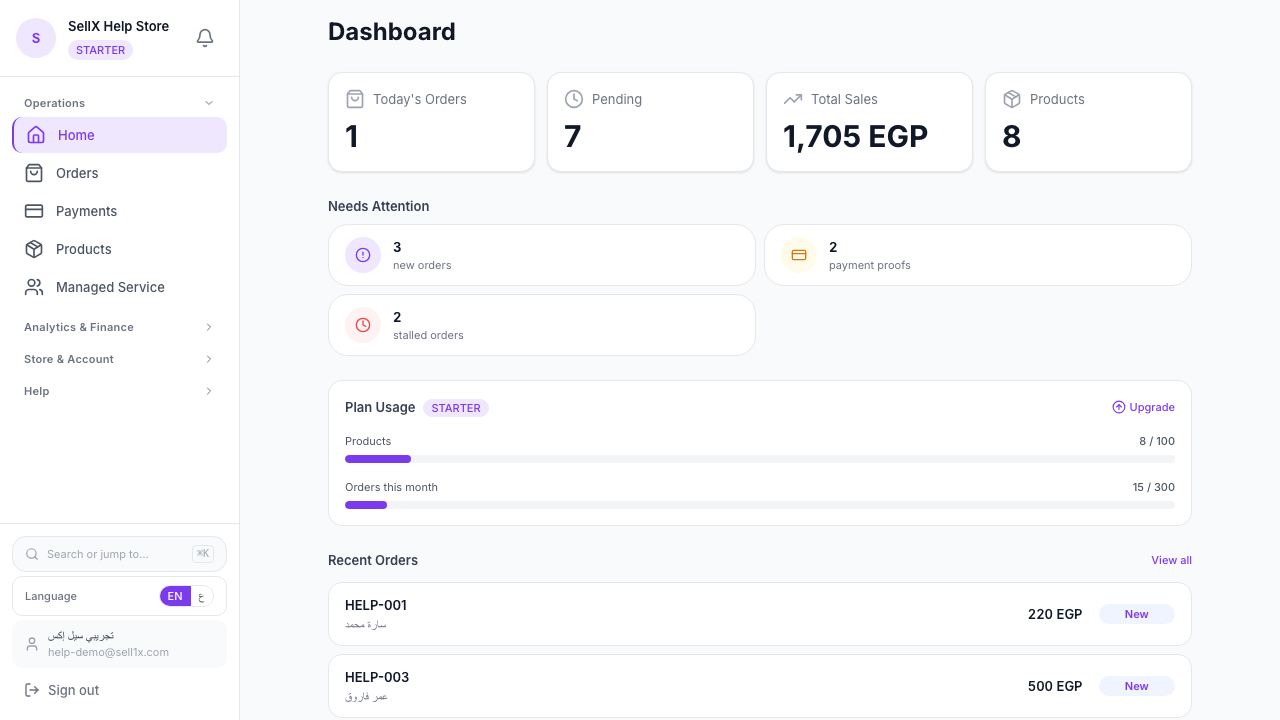
sellX plans are in EGP, flat, and 0% commission on your sales. Features like cash-on-delivery confirmation, coupons, order bumps, and funnels are built in — not apps you pay for separately. You know your end-of-month bill before you start, and it isn't affected by the dollar.
When Shopify is still the right choice
To be fair — Shopify is a powerful platform, and in some cases it's the better fit:
- You sell outside Egypt in multiple currencies
- You have a huge catalog or deep customization needs and a developer team
- You need a wide global app marketplace for specific integrations
If your business is cash on delivery in Egypt and you want a flat EGP cost with no commission, sellX is cheaper and simpler.
Frequently asked questions
Shopify doesn't take a sales commission, right? Shopify doesn't take a cut if you use Shopify Payments — but that's not available in Egypt, so you pay a third-party gateway fee (2% on the Basic plan) on every order paid online, on top of your gateway's own fee. Cash-on-delivery orders don't pay it.
Does sellX take a cut of my sales? No. 0% commission. You pay only the flat EGP plan subscription. Cash on delivery stays between you and your customer — sellX never holds your money.
Are these numbers accurate? They're estimates to illustrate the point, and they change with the dollar rate, your apps, and your sales volume. That's why the guide shows you how to calculate your own bill with your numbers.
How do I move from Shopify to sellX? You can start a free sellX store and add your products gradually. For the full platform comparison, see sellX vs Shopify and WooCommerce.
What if I sell outside Egypt? If most of your selling is international across multiple currencies, Shopify may fit better. sellX specializes in the Egyptian market and cash on delivery in EGP.
Bottom line
The plan price isn't the bill. Once you add the commission, the apps, and the dollar bill, Shopify in Egypt comes out at several times what you expected. sellX gives you one flat EGP number with no commission and apps built in — calculate your bill with your own numbers and compare for yourself.
Start your free store and compare →
Read next: sellX vs Shopify and WooCommerce